
Discovering termites in your home ranks somewhere between finding a mystery leak and realizing your foundation has a crack. It’s expensive, stressful, and time-sensitive. Understanding what you’ll actually pay, not the scary high-end estimates pest companies toss around, helps you budget, compare quotes, and make smart decisions about protecting your biggest investment. Termite treatment costs vary widely based on infestation size, treatment method, and home structure, but most homeowners should expect to spend between $250 and $2,500 for professional service. This guide breaks down the real numbers, the factors that drive pricing, and where you can trim costs without gambling on your home’s structural integrity.
Table of Contents
ToggleKey Takeaways
- Most homeowners should budget between $1,000 and $2,500 for professional termite treatment, with liquid termiticides and bait station systems offering different cost-benefit tradeoffs.
- Liquid termite treatments cost $3 to $16 per linear foot and provide immediate protection lasting 5–10 years, while bait stations require lower upfront investment but annual monitoring fees of $300–$500.
- Foundation type, infestation severity, geographic location, and landscaping accessibility are the primary factors driving termite treatment costs beyond the base method price.
- DIY termite treatment supplies cost $120–$500 but risk improper application and missing protection gaps; professional services include liability insurance, warranties, and expertise identifying termite species.
- Getting three quotes, scheduling during off-peak seasons (fall/winter), bundling with pest control services, and addressing moisture issues can save $200–$400 while maintaining effective termite treatment.
- Untreated termite infestations result in costly structural repairs and resale value losses, making professional treatment a smart investment in protecting your home’s foundation.
Average Cost of Termite Treatment by Method
Treatment method is the single biggest cost driver. Pest control companies use two primary approaches, each with different pricing structures and long-term value propositions.
Liquid Termite Treatments
Liquid termiticides create a chemical barrier around your foundation that kills termites on contact and prevents new colonies from entering. Professional application typically costs $3 to $16 per linear foot of foundation, with most homes averaging $1,200 to $2,500 for complete perimeter treatment.
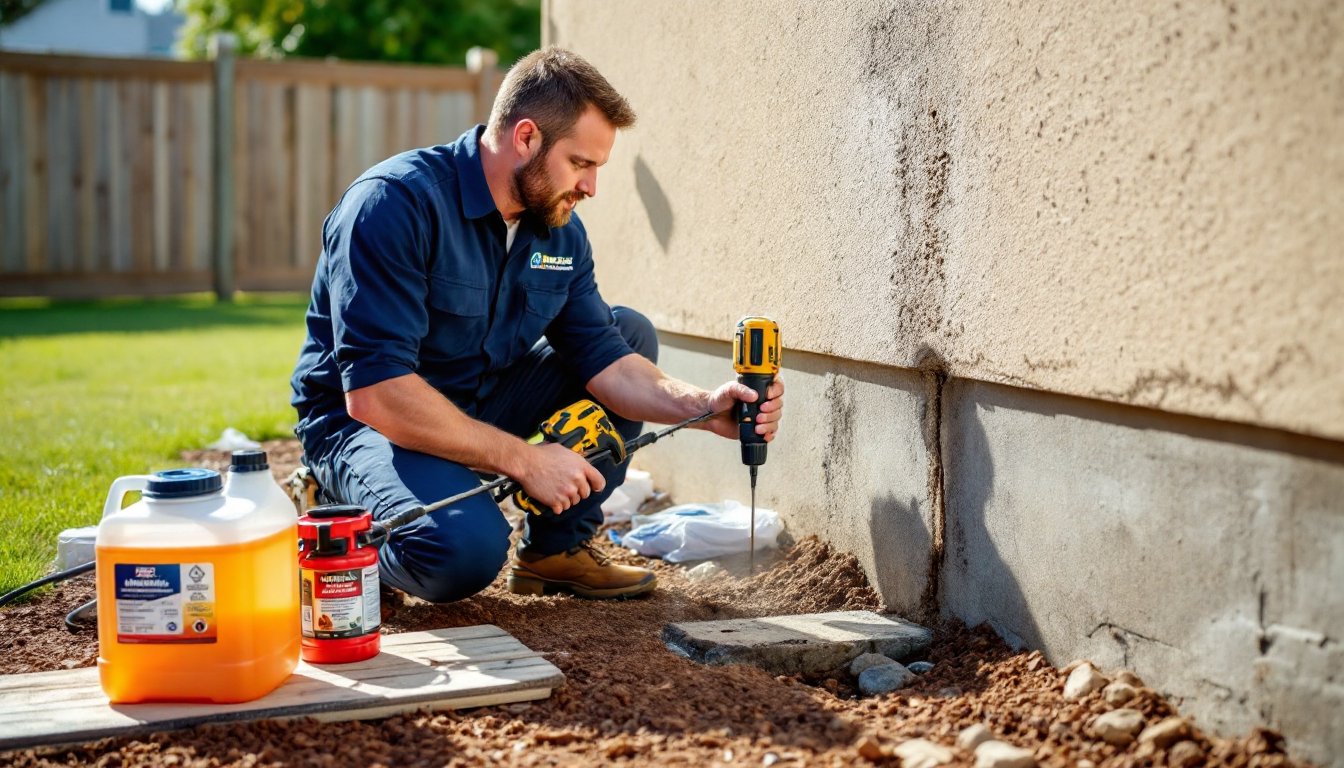
The process involves drilling holes every 12 to 18 inches around your foundation, injecting termiticide into the soil, and sometimes trenching along exterior walls. It’s labor-intensive but effective immediately. Products like Termidor or Taurus SC remain active in soil for five to ten years, though most companies recommend annual inspections.
Liquid treatments work best for active infestations requiring immediate knockdown. The upfront cost is higher than bait systems, but you’re not paying for ongoing monitoring visits. Expect to spend $1,000 to $1,500 for a typical 1,800-square-foot home on a slab foundation, more if you have a basement or crawlspace requiring interior treatment.
Bait Station Systems
Bait stations use slow-acting toxins that termites carry back to the colony, eventually eliminating the queen and collapsing the entire population. Installation costs $8 to $12 per linear foot initially, then $300 to $500 annually for monitoring and bait replenishment.
Technicians install stations every 10 to 20 feet around the perimeter, just below soil level. Termites discover the bait, consume it, and share it through trophallaxis (termite food-sharing behavior). Colony elimination takes three to six months, sometimes longer for mature colonies.
Bait systems make sense for preventative treatment or mild infestations where you can afford the slower timeline. The lower initial cost appeals to homeowners on tight budgets, but the annual monitoring fees add up. Over five years, many homeowners spend more on bait systems than they would’ve on a one-time liquid treatment.
Factors That Affect Your Termite Treatment Price
Square footage matters less than you’d think. Companies primarily charge based on linear footage of foundation and accessibility, not interior square footage.
Infestation severity drives pricing significantly. Light activity near one corner? You might get spot treatment for $250 to $500. Active mud tubes on multiple walls with structural damage visible? Expect full-perimeter treatment plus wood repair, potentially $2,500 to $5,000 or more.
Foundation type affects labor costs. Slab foundations are easiest to treat, drill, inject, done. Basements require interior and exterior treatment. Crawlspaces mean technicians working in cramped, unpleasant conditions, often increasing labor charges by 20 to 30 percent. Pier-and-beam foundations need treatment of both soil and wooden supports.
Geographic location influences both material costs and termite pressure. The Southeast and Gulf Coast deal with aggressive Formosan termites requiring more intensive treatment. Industry data shows homeowners in humid climates typically spend 15 to 25 percent more than those in arid regions. Regional termite treatment pricing varies by local labor rates and competitive market conditions.
Landscaping and hardscaping create access issues. Concrete patios poured against the foundation require drilling through concrete, expect additional charges of $200 to $600. Mature landscaping beds, sprinkler systems, and decorative rock all complicate treatment and add labor time.
Warranty and inspection packages add $75 to $200 annually but provide peace of mind and usually cover retreatment if termites return during the coverage period. Some lenders require termite bonds for mortgages in high-risk areas.
DIY vs. Professional Termite Treatment: Cost Comparison
DIY liquid treatment products cost $50 to $200 for enough concentrate to treat a typical home perimeter. You’ll also need a pump sprayer or injection system ($30 to $150), drill and masonry bits ($40 if you don’t own them), and personal protective equipment including chemical-resistant gloves, goggles, and respirator.
Total DIY material cost: $120 to $500 for first-time treatment. Sounds attractive compared to $1,500 professional service, right?
Here’s the reality check. Termiticide application requires precise dilution ratios, too weak and you won’t kill the colony, too strong and you’re wasting expensive product or creating environmental hazards. You need to apply four gallons of finished solution per ten linear feet at the correct depth and spacing. Miss a gap in your chemical barrier and termites will find it.
Professionals carry liability insurance, know how to treat difficult access areas, and provide warranties. Most importantly, they know whether you’re dealing with subterranean termites, drywood termites, or dampwood termites, each requiring different treatment approaches.
DIY makes sense for preventative treatment on new construction before landscaping goes in, or for homeowners with pest control experience tackling very light infestations. For active infestations causing visible damage, professional treatment isn’t optional, it’s risk management. Most professional termite services include inspection, treatment, and monitoring that DIY approaches can’t match.
Bait station systems aren’t practical DIY projects. The stations themselves are available, but effective monitoring requires trained eyes to identify termite activity and adjust bait placement strategically.
How to Save Money on Termite Treatment Without Cutting Corners
Get three quotes minimum. Termite treatment pricing varies wildly between companies, sometimes by 40 percent or more for identical work. Make sure quotes include the same scope, some companies lowball the estimate then upsell during treatment.
Schedule during off-peak season. Pest control companies stay busy March through June when termite swarms appear and homeowners panic. Book treatment in fall or winter and you’ll often negotiate 10 to 15 percent discounts plus faster scheduling.
Handle minor prep work yourself. Moving firewood piles, clearing mulch from the foundation perimeter, and trimming vegetation saves technicians time. Some companies reduce quotes by $100 to $200 if you prep the work area.
Bundle with annual pest control. Companies offer package deals combining termite treatment with general pest control, often saving $200 to $400 annually compared to separate services.
Address moisture issues before treatment. Fixing leaky gutters, improving drainage, and repairing plumbing leaks makes treatment more effective and reduces reinfestation risk. Resources like home improvement cost guides help budget these preventative repairs alongside pest control.
Ask about spot treatment. If infestation is genuinely localized to one area, targeted treatment costs $250 to $600 versus full-perimeter pricing. But, only accept this if a thorough inspection confirms limited activity, termites often have multiple entry points.
Verify your homeowner’s insurance. Most policies exclude termite damage, but some cover treatment costs if the infestation resulted from a covered peril like sudden plumbing failure. Worth a phone call before paying out-of-pocket.
Skip the yearly warranty if you’re selling soon. Annual renewal fees don’t make financial sense if you’re listing the house within 18 months. Instead, get a one-time treatment and provide a termite clearance letter to buyers.
Conclusion
Termite treatment costs sting, but untreated infestations cost more, both in structural repairs and resale value hits. Most homeowners spend between $1,000 and $2,000 for professional treatment that protects their home for years. Get multiple quotes, understand exactly what treatment method fits your situation, and don’t let cost pressure you into DIY work that’s truly beyond your skill level. The cheapest treatment is the one that actually works.