
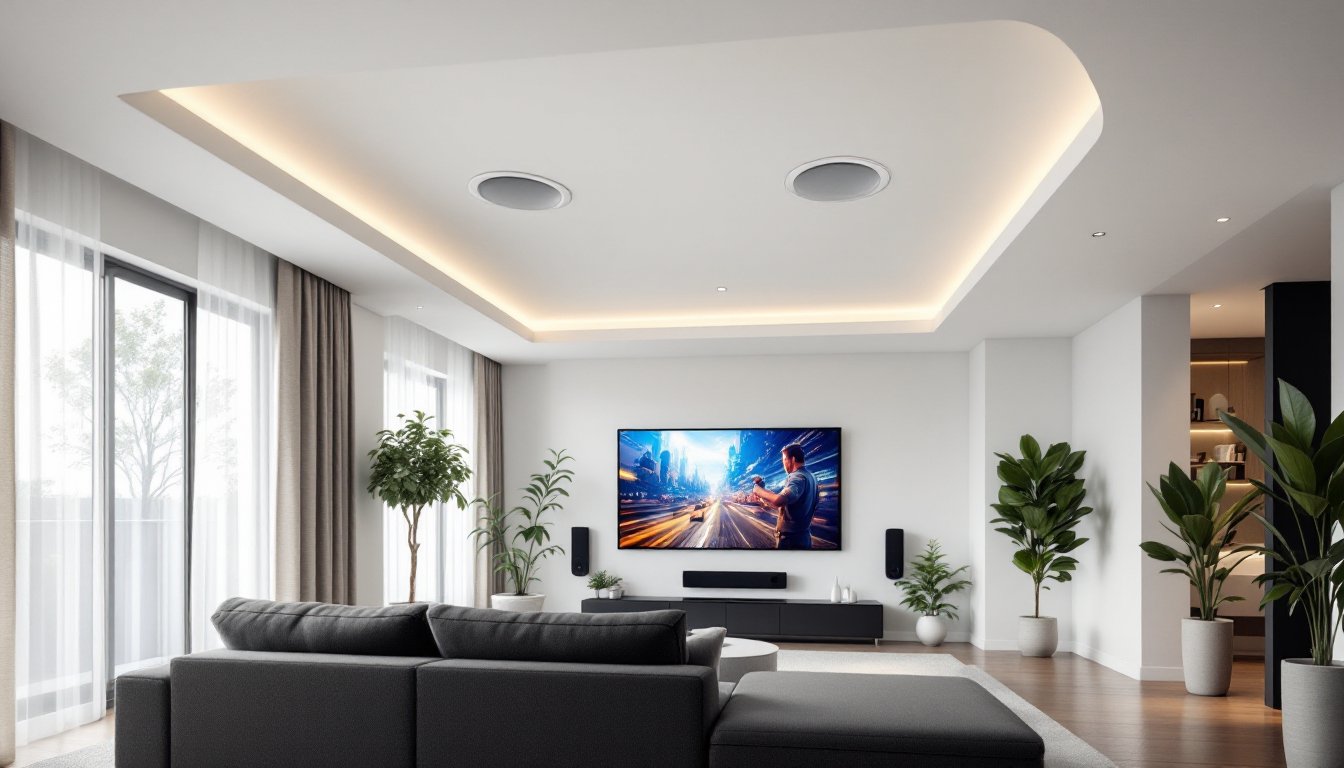
Most homeowners who invest in a quality TV and soundbar eventually hit the same wall: the audio feels flat, dialogue gets lost, and there’s no sense of space. The missing piece isn’t a bigger subwoofer, it’s overhead sound. Ceiling speakers transform a living room into a legitimate home theater by adding dimension that floor-level equipment can’t replicate. Whether someone’s building a dedicated media room or upgrading an existing setup, ceiling speakers offer clean aesthetics and true surround sound without cluttering the floor. This guide covers everything needed to choose, install, and position ceiling speakers for maximum impact.
Table of Contents
ToggleKey Takeaways
- Ceiling speakers add immersive, three-dimensional overhead sound that transforms a home theater by enabling true surround effects and Dolby Atmos content without cluttering floor space.
- In-ceiling speakers provide the cleanest aesthetic appearance with flush installation, while on-ceiling (surface-mount) models offer a practical alternative when cutting drywall isn’t feasible.
- Proper ceiling speaker placement at 45–65 degrees from listener ears in front and rear positions creates optimal sound dispersion for height channels in 5.1.4 or 7.1.4 Dolby Atmos setups.
- Room size and ceiling height determine ideal speaker size: 6.5-inch models work for spaces under 200 square feet, while larger areas benefit from 8-inch models with 90 dB or higher sensitivity ratings.
- DIY installation of ceiling speakers is achievable with attic access and standard drywall construction, but professional installation ($100–$200 per speaker) is recommended for complex ceilings, no attic access, or permit-required scenarios.
- Atmos-certified height channel speakers with aimable tweeters and wide dispersion patterns deliver noticeably better localization of overhead effects compared to standard in-ceiling models.
Why Ceiling Speakers Are a Game-Changer for Home Theaters
Ceiling speakers solve two major problems: space constraints and immersive audio. Traditional tower speakers and surround stands eat up floor space, collect dust, and get knocked over by pets or kids. Ceiling-mounted units disappear into the architecture while delivering sound from above, creating a three-dimensional listening experience that matches what theaters achieve with overhead arrays.
The real advantage shows up in Dolby Atmos and DTS:X content, which uses height channels to place sounds precisely in a 3D space, rain falling from above, helicopters passing overhead, or debris scattering across the ceiling. Without height speakers, that layer collapses into the front soundstage, losing the effect entirely.
For homeowners who care about aesthetics, ceiling speakers eliminate visible wires and bulky boxes. A properly installed in-ceiling speaker blends into white or textured ceilings with only a slim grille visible. Resale value doesn’t take a hit, and the room’s layout stays flexible. Paint-ready grilles can be color-matched to the ceiling, making them nearly invisible.
Another practical benefit: ceiling speakers work in rooms where wall-mounting isn’t possible. Homes with large windows, open-concept layouts, or brick walls can’t always accommodate traditional surround speakers. Overhead placement bypasses those issues, delivering consistent coverage without compromising the room’s design.
Types of Ceiling Speakers for Home Theater Systems
In-Ceiling vs. On-Ceiling Speakers
The first decision is installation method. In-ceiling speakers mount flush with the ceiling surface, requiring a cutout in drywall and access to the cavity above. They deliver the cleanest look and the most consistent sound dispersion, since the driver sits in an enclosed space (the ceiling cavity acts as a natural enclosure). Most models fit into standard 16-inch on-center joist spacing, though retrofit brackets are available for tricky placements.
On-ceiling (surface-mount) speakers attach directly to the ceiling surface without cutting holes. They’re the go-to option for concrete ceilings, finished basements with no attic access, or situations where cutting into drywall isn’t practical. The tradeoff: they’re more visible (usually 4–6 inches deep) and may require external enclosures for optimal bass response. Sound quality can match in-ceiling models, but aesthetics suffer.
For home theater use, in-ceiling is the standard choice unless structural or access issues rule it out. Surface-mount speakers work better for outdoor patios, garages, or commercial spaces where visibility isn’t a concern.
Dolby Atmos and Height Channel Speakers
Not all ceiling speakers are built for Dolby Atmos. Height channel speakers (designated as “.4” channels in a 5.1.4 or 7.1.4 setup) need to meet specific design criteria: wide dispersion, angled drivers, or dedicated upfiring configurations. Some models feature aimable tweeters, letting installers direct high frequencies toward the primary seating area for better clarity.
Atmos-certified speakers often include dual tweeters or concentric driver designs to create a larger sweet spot. The goal is to reflect sound off the ceiling (for upfiring modules) or disperse it evenly across the room (for true in-ceiling height channels). Standard in-ceiling speakers can work in a pinch, but dedicated Atmos models deliver noticeably better localization and overhead effects.
Another consideration: passive vs. powered speakers. Most ceiling speakers are passive, requiring a separate AV receiver or amplifier. Powered (active) ceiling speakers include built-in amplification and sometimes wireless connectivity, simplifying installation but limiting flexibility. Passive models dominate home theater because they integrate cleanly with multi-channel receivers and offer better long-term upgradeability.
How to Choose the Right Ceiling Speakers for Your Space
Start with room size and ceiling height. Rooms under 200 square feet can get by with a pair of 6.5-inch in-ceiling speakers for height channels, while larger spaces (300+ square feet) benefit from 8-inch models with higher sensitivity ratings (90 dB or above). Ceilings over 10 feet high need speakers with greater power handling (75–100 watts) to maintain output without distortion.
Next, match impedance to the amplifier or receiver. Most home theater speakers run at 8 ohms, but some ceiling models offer 4-ohm or 6-ohm options for higher efficiency. Check the AV receiver’s specs, running 4-ohm speakers on a receiver rated for 8 ohms can trigger thermal shutdown or damage the amp over time.
Frequency response matters less than many spec sheets suggest, but aim for models that extend down to 50–60 Hz if they’re doubling as surrounds. Ceiling speakers won’t replace a dedicated subwoofer for deep bass, but decent low-end extension prevents a “thin” sound during dialogue-heavy scenes.
Look for moisture-resistant or IP-rated models if installing in a basement, bathroom, or climate-controlled space with high humidity. Standard paper-cone speakers degrade quickly in damp environments: polypropylene or treated woofers last longer.
Some of the best in-ceiling speakers for home theater include models with tool-free installation clamps, which speed up DIY projects significantly. Paint-ready grilles and magnetic retention systems make future maintenance easier, no screws to strip or grilles to crack during removal.
Installing Ceiling Speakers: DIY vs. Professional Installation
Installing ceiling speakers is a moderate DIY project if there’s clear attic access and the ceiling is drywall over standard wood framing. Here’s what the process involves:
- Locate joists using a stud finder. Mark speaker locations, keeping them at least 1 foot from HVAC ducts, electrical boxes, and load-bearing beams.
- Trace the speaker template (included with most models) onto the ceiling. Double-check clearance above using an inspection camera or by measuring from the attic.
- Cut the drywall with a drywall saw or oscillating multi-tool. A jab saw works, but a multi-tool gives cleaner edges and less dust.
- Run speaker wire from the AV receiver to each cutout. Use 16-gauge or 14-gauge CL2- or CL3-rated wire for in-wall/in-ceiling runs. Staple wire to joists every 18 inches to meet code. Leave 12–18 inches of slack at each speaker location.
- Strip wire ends and connect to speaker terminals (red to positive, black to negative). Most retrofit models use spring-loaded clamps or rotating dogs that grip the drywall when the speaker is inserted.
- Secure the speaker by tightening mounting screws or flipping clamps. Install the grille.
This assumes standard 1/2-inch or 5/8-inch drywall and accessible ceiling cavities. If the ceiling is plaster, tongue-and-groove planks, or a suspended drop ceiling, the process changes significantly.
When to hire a professional:
- No attic access (slab construction, condos, multi-story homes where the ceiling is also the floor above).
- Popcorn or asbestos ceilings require special handling and potential abatement.
- Commercial-grade soundproofing or back boxes (enclosures that prevent sound bleed between floors).
- Whole-home audio integration with multi-zone amplifiers, network streaming, and centralized control.
- Permit requirements (some jurisdictions require permits for low-voltage wiring, especially if running wire through fire-rated assemblies).
Expect professional installation to cost $100–$200 per speaker for labor, not including wire or materials. It’s worth it for complex runs, finished basements, or situations where a ceiling patch job would be costly.
Placement and Positioning Tips for Optimal Sound
For Dolby Atmos height channels, the standard configuration is two or four speakers positioned above or slightly in front of the primary seating area. In a 5.1.4 setup, place two height speakers 2–3 feet in front of the main listening position and two 2–3 feet behind, angled toward the center. Avoid placing them directly overhead, that creates a “hole” in the soundstage. The goal is a 45–65 degree angle from the listener’s ears to the speaker.
In rectangular rooms, maintain symmetry. If the couch sits 10 feet from the front wall, front height speakers should be 12–13 feet from that wall, with rear height speakers 7–8 feet from the back wall. This creates an even dome of sound rather than a lopsided effect.
Avoid installation near ceiling fans, recessed lights, or HVAC vents. Vibration from a fan will rattle speaker grilles, and airflow from vents introduces noise into the listening space. Maintain at least 18 inches of clearance from these fixtures.
For rooms with vaulted or angled ceilings, use aimable tweeters or models with wide dispersion patterns (90–120 degrees). Flat ceilings allow more flexibility, but sloped ceilings require careful aiming to avoid sound washing over the seating area without delivering clear dialogue or effects.
Test placement before cutting holes. Many installers recommend expert-tested models with adjustable tweeters to fine-tune aim after installation. Use painter’s tape to mark proposed locations, sit in the primary seat, and visualize the sound path. Move marks as needed.
Safety note: Always wear safety goggles and a dust mask when cutting drywall. Turn off power to any nearby electrical circuits before drilling or cutting to avoid hitting live wires. If unsure about what’s behind the ceiling, use a non-contact voltage tester and an endoscope camera.
Ceiling speakers aren’t a plug-and-play upgrade, they require planning, patience, and attention to detail. But when done right, they turn a living room into an immersive experience that rivals commercial theaters, without the clutter or expense of a full floor-standing surround system.