
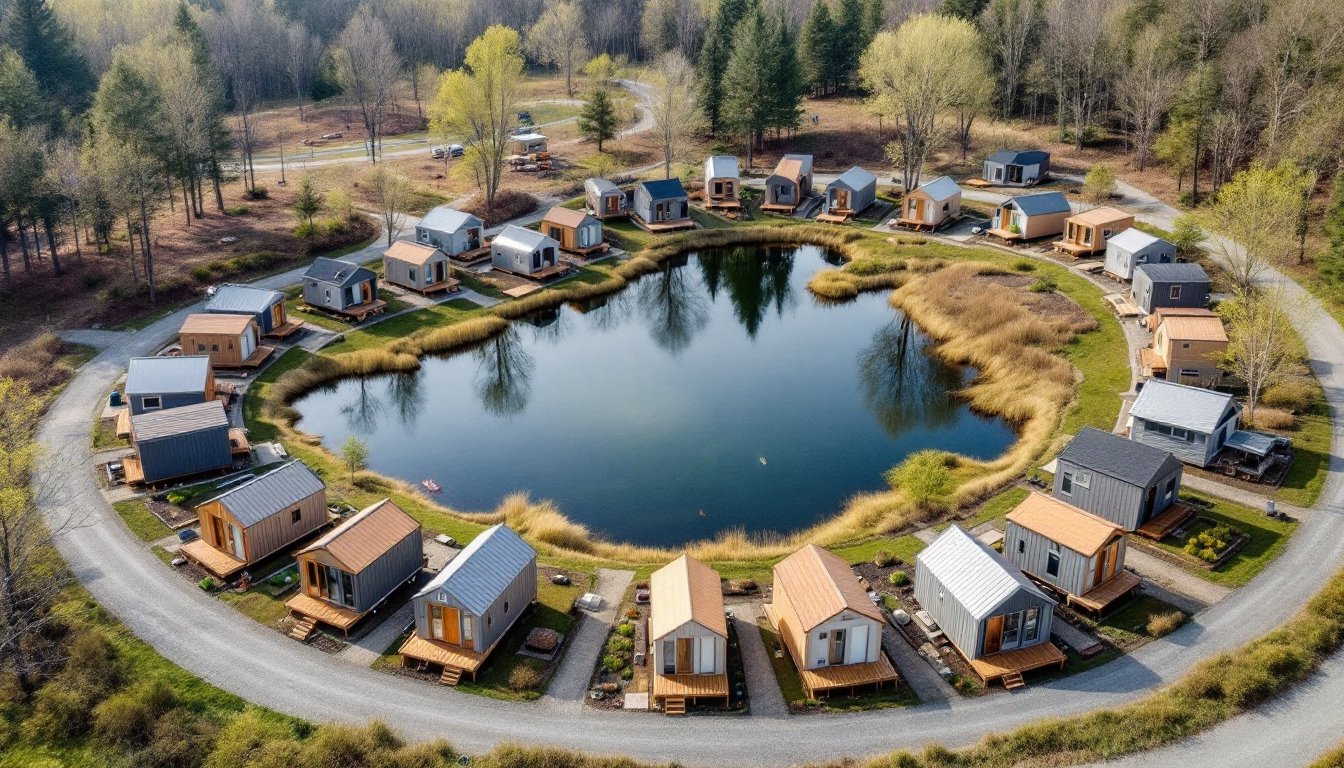
Circle Pond isn’t your typical tiny home park where residents drag in prefab units and call it a day. This purpose-built community in rural New England merges small-footprint living with collective infrastructure, shared utility connections, communal green space, and a development framework designed from the ground up for permanence. As housing costs continue climbing and zoning laws slowly catch up to alternative dwelling trends, Circle Pond represents one of the first legally recognized tiny home communities where owners hold actual equity in both their structure and the land beneath it. For DIYers and builders exploring downsized living without sacrificing stability or resale value, this project offers a working model worth examining closely.
Table of Contents
ToggleKey Takeaways
- Circle Pond is a purpose-built tiny home community in Vermont where residents own their lots and homes outright, not just rent pads, providing true equity and resale value.
- Lot prices range from $45,000–$62,000 with monthly HOA fees of $185–$210, making this tiny home community more affordable than standalone rural properties when shared infrastructure costs are included.
- The development required nearly two years of planning to secure special-use permits under Vermont’s Act 170, demonstrating the legal framework now exists to legitimize tiny homes as permanent single-family dwellings.
- Shared amenities—including a 3,200 SF workshop with full tools, community kitchen, guest cabin, and fiber internet—create built-in support systems that reduce the isolation of DIY building.
- Owner-builders can complete a tiny home in 8–14 months working part-time by following code-compliant standards for foundations, framing, insulation, and utilities, with professional inspections at key phases.
- Circle Pond solves the tiny home movement’s two biggest obstacles: legal ambiguity through PUD approval and land access through shared infrastructure, creating a sustainable model for affordable, permanent downsized living.
What Is Circle Pond Tiny Home Community?
Circle Pond is a planned tiny home development located on approximately 12 acres in central Vermont, consisting of 24 residential plots arranged around a central pond and common green. Each plot ranges from 2,400 to 3,200 square feet, large enough for a tiny home (typically 100–400 SF), outdoor deck, and small garden area, but compact enough to preserve open land for collective use.
Unlike mobile home parks where residents rent pads, Circle Pond operates as a condominium association. Homeowners purchase their individual lots while sharing ownership of roads, utility infrastructure, the pond, and community buildings through monthly HOA fees. The development received special-use permits under Vermont’s Act 170, which allows tiny homes on permanent foundations to be classified as single-family dwellings if they meet IRC standards for habitable space.
All structures must be on permanent foundations (pier-and-beam, slab, or frost-protected shallow foundation), connected to municipal water and septic systems, and comply with state electrical and plumbing codes. Wheels-on tiny homes and RVs aren’t permitted for full-time occupancy, though they can be used as temporary housing during construction.
The Vision Behind Circle Pond’s Design and Development
Circle Pond was initiated by a local land trust and a group of builders frustrated by the gap between tiny home enthusiasm and the lack of legal places to put them. Most municipalities zone tiny homes out of existence, either by minimum square footage requirements (often 600–800 SF) or by classifying them as recreational vehicles.
The developers worked with the town planning board for nearly two years to craft a Planned Unit Development (PUD) that met safety and density standards without forcing homes to balloon beyond tiny-home scale. Key design principles included:
- Clustered lots to preserve 60% of the parcel as permanent open space and wetland buffer
- Shared infrastructure (one water main, centralized septic leach field, common gravel road) to reduce per-unit costs
- Design guidelines rather than rigid architectural controls, homes must use durable siding (fiber cement, metal, or wood), metal or asphalt shingle roofing, and earth-tone exteriors, but layout and interior finishes are owner-determined
- Community buildings including a shared workshop, tool library, and gathering hall with commercial kitchen
The layout draws from modern cohousing principles, where private dwellings encircle communal amenities, encouraging interaction without forced socializing. Homes face inward toward the pond and green, while parking and utility access stay on the perimeter.
Cost Breakdown: What It Takes to Join Circle Pond
As of early 2026, lot prices at Circle Pond range from $45,000 to $62,000 depending on size, pond proximity, and solar exposure. That purchase includes:
- Deeded ownership of the building lot
- Proportional share of common land and amenities
- Water and septic tap-in fees
- Access to shared electric service (individual meters installed at owner expense)
Monthly HOA fees run approximately $185–$210, covering road maintenance, snow removal, liability insurance, common building upkeep, and reserve fund contributions.
Construction costs vary widely. A DIY builder using reclaimed materials and sweat equity might complete a 200 SF shell for $20,000–$30,000. A contractor-built, fully finished 350 SF home with loft, mini-split HVAC, and quality fixtures typically runs $75,000–$95,000, or roughly $250–$270 per square foot, higher than conventional construction due to the efficiency demands of small-space systems and the premium on compact, multi-functional fixtures.
Down Payment and Financing Options
Most traditional mortgage lenders won’t finance tiny homes under 400 SF or structures not meeting Fannie Mae minimums. Circle Pond buyers typically use one of three paths:
- Cash purchase of the lot, then a personal loan or HELOC for construction
- Owner financing through the land trust (available on select lots, 20% down, 7-year balloon at 6.5% APR as of 2026)
- Credit union construction loans, a few regional lenders in Vermont offer them for owner-built tiny homes if the borrower can demonstrate builder experience or hires a licensed general contractor
Down payments for financed lots run 20–30%, higher than conventional real estate due to the niche market and resale uncertainty.
Community Amenities and Shared Spaces
Circle Pond’s communal infrastructure is what separates it from a standard subdivision. The 3,200 SF workshop includes a table saw, miter saw, drill press, welding station, and lumber rack, all available to residents through a simple reservation system. Tool library membership is included in HOA fees.
The gathering hall seats roughly 40, with a commercial range, double oven, and walk-in pantry. It’s used for potlucks, workshops, and private events. Residents also share:
- Guest cabin (one-bedroom, available for visiting family: reservations via online calendar)
- Community garden plots (12’x12′ raised beds, irrigation from pond via solar pump)
- Fire pit and outdoor pavilion with picnic tables and grill
- Pond access for non-motorized recreation (kayaks, swimming, ice skating)
Utility design deserves mention. The development uses a shared septic system rated for 30 bedrooms (a buffer above the 24-unit max), engineered with a sand filter and leach field in the designated drainage area. Each home connects via individual lateral lines. Electric service enters the property at a single transformer, then splits to individual metered pedestals at each lot, owners contract directly with the utility for billing.
Internet comes from a fiber line running to a central router in the workshop: residents can tap into the shared network or contract for individual service. As of 2026, many who work remotely have found the shared high-speed connection adequate for video calls and cloud-based work.
Building Your Own Tiny Home at Circle Pond: A DIY Guide
Circle Pond encourages owner-builders but requires all work to pass inspection by a Vermont-licensed third-party inspector at key phases: foundation, framing, rough plumbing and electrical, insulation, and final. Here’s the realistic scope:
Foundation: Most builders choose pier-and-beam using sono tubes filled with rebar and concrete, topped with 6×6 pressure-treated posts and double 2×8 or engineered lumber rim joists. Frost depth in Vermont is 48 inches, so piers must extend below that line. Budget 2–3 days for layout and pour, plus curing time. A skid-steer or mini-excavator (available for rent at the community workshop) speeds the dig.
Framing: Standard 2×4 wall framing at 16″ on center works, but many builders use 2×6 studs at 24″ OC for better insulation value (R-21 vs. R-13). Roof trusses can be site-built or ordered pre-fab: most Circle Pond homes use a simple gable or shed roof with metal roofing for longevity. You’ll need a framing nailer, circular saw, speed square, and level. A miter saw makes trim and rafter cuts cleaner, but a circular saw with a guide works if that’s what you’ve got.
Insulation and Air Sealing: This is where tiny homes succeed or fail. Use closed-cell spray foam in rim joists and around window rough openings (hire a pro for this, DIY kits rarely achieve code-required R-values). Wall and ceiling cavities can use fiberglass batts, mineral wool, or blown cellulose, but you must install a continuous air barrier (house wrap outside, vapor-retarder poly or painted drywall inside). Tiny homes lose heat fast, and moisture from cooking and showering condenses inside walls if the envelope isn’t tight.
Plumbing and Electrical: Both require permits and inspections. If you’re not a licensed tradesperson, hire out the rough-in and have a pro check your work before closing walls. PEX plumbing is DIY-friendly and freeze-resistant if you insulate supply lines in exterior walls. Electrical in tiny homes often uses a 100-amp service panel, adequate for a mini-split heat pump, electric range, and outlets. Follow NEC guidelines for GFCI protection in kitchens and baths.
Safety Gear: Throughout the build, wear safety glasses, work gloves, hearing protection when operating power tools, and a respirator during insulation install and any spray finishing. Vermont winters are no joke, install temporary heat sources carefully and keep CO detectors on-site if using propane.
Most owner-builders at Circle Pond finish their homes in 8–14 months working weekends and evenings, or 4–6 months if building full-time. Don’t skip the material acclimation step, let lumber, drywall, and trim sit inside the framed shell for a few days before install to prevent warping and cracking as moisture levels equalize.
Why Circle Pond Is Redefining Tiny Home Living in 2026
Circle Pond solves the two biggest obstacles facing the tiny home movement: legal ambiguity and land access. By securing PUD approval and requiring permanent foundations and code compliance, it legitimizes tiny homes as real property with mortgageability and resale potential. The condominium structure gives owners true equity, not just a lease on a pad.
The shared-infrastructure model also reduces the barrier to entry. Installing a private well, septic, and electric service on a standalone rural lot can easily exceed $30,000. At Circle Pond, those costs are split across 24 units and built into the lot price, lowering the up-front cash requirement.
From a DIY perspective, the community tool library and mutual aid culture provide practical support that solo builders rarely get. Need help lifting trusses? There’s a group text. Not sure how to flash a window in a rain screen? Someone three lots over just did it last month.
The model isn’t without limitations. HOA fees and design covenants won’t appeal to those seeking total autonomy. Resale markets for tiny homes remain thinner than conventional housing, though Circle Pond’s legal structure improves that outlook. And Vermont’s climate demands robust building envelopes, budget and skill requirements are real.
But for builders and buyers serious about downsized, efficient living with the security of ownership and community support, Circle Pond provides a tangible template. It’s not a lifestyle fantasy, it’s a permitted, financed, inspect-able development where people are living year-round in homes they built themselves, on land they own, in a framework designed to last.