
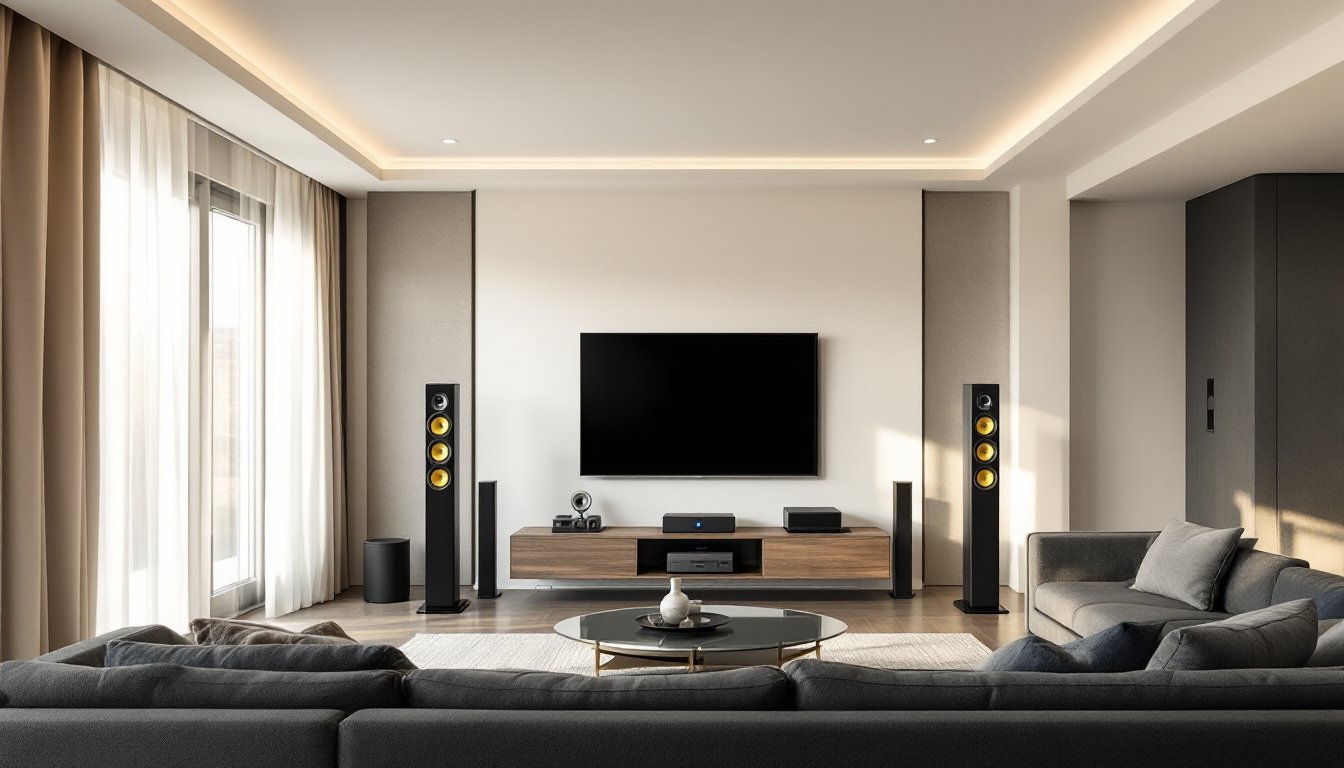
Setting up a home theater isn’t just about buying speakers and plugging them in. It’s about creating an immersive environment where sound moves through the room the way a director intended, crisp dialogue, thundering bass, and spatial effects that make viewers forget they’re sitting on their own couch. Bowers & Wilkins has built its reputation on delivering that level of precision, combining British engineering with acoustic science that most consumer brands skip. For DIYers willing to invest in quality components and take installation seriously, a Bowers & Wilkins home theater offers a measurable upgrade over mass-market systems, but only if the room, placement, and calibration are handled correctly.
Table of Contents
ToggleKey Takeaways
- Bowers & Wilkins home theater systems deliver precision sound through advanced driver technology and cabinet design that reduce distortion, but proper room treatment and calibration are essential for optimal performance.
- A complete Bowers & Wilkins setup ranges from $2,500 to $15,000+ depending on the series, with phased purchasing (starting with 3.1 configuration) allowing homeowners to spread costs and test room performance.
- Room dimensions, ceiling height, and acoustic treatment directly impact speaker placement and sound quality, with optimal rectangular rooms sized between 12×16 and 20×30 feet.
- Proper subwoofer integration at 80 Hz crossover frequency and phase alignment between subwoofer and main speakers prevents bass cancellation and ensures tight, clear bass response.
- DIY installation requires attention to speaker placement using the equilateral triangle rule, safe wall mounting with stud finders, and code-compliant CL3-rated wire routing to achieve professional results.
- Room correction software calibration from multiple seating positions, tweeter alignment at ear level (36–42 inches), and speaker positioning adjustments in 6-inch increments fine-tune soundstage and frequency response.
Why Choose Bowers & Wilkins for Your Home Theater System
Bowers & Wilkins speakers stand apart because of their driver technology and cabinet design. The company uses Continuum cone midrange drivers and diamond dome tweeters in many of their higher-end models, materials chosen for stiffness-to-weight ratios that reduce distortion at high output levels. This matters in home theater applications where dynamic range swings from whisper-quiet dialogue to explosion sequences without compression.
The brand’s Matrix bracing inside cabinets minimizes resonance, which keeps sound clean even when multiple drivers are working hard. Cheaper enclosures vibrate and color the output, especially during bass-heavy scenes. Bowers & Wilkins builds cabinets with internal cross-bracing that dampens unwanted vibrations, so what comes out of the speaker is closer to the source signal.
Another practical advantage: modular component options. Homeowners can start with a basic 3.1 setup, left, center, right speakers plus a subwoofer, and expand to 5.1, 7.1, or even Dolby Atmos configurations as budget allows. The 600 Series and 700 Series speakers share similar tonal characteristics, which means adding surrounds or height channels later won’t create mismatched sound.
Bowers & Wilkins also offers wireless options within their Formation line, including models that integrate with traditional AV receivers or operate as standalone networked systems. These aren’t compromise solutions, reviews from sources like audiophile wireless speaker tests confirm that Bluetooth isn’t the bottleneck when the processing and DAC quality are this high.
Planning Your Bowers & Wilkins Home Theater Setup
Room Size and Acoustic Considerations
Room dimensions dictate speaker placement more than personal preference does. A rectangular room between 12×16 feet and 20×30 feet gives enough space for proper speaker separation without requiring commercial-grade amplification. Smaller spaces, under 10×12 feet, suffer from bass buildup in corners, and larger rooms above 25×35 feet often need additional speakers or in-wall solutions to maintain even coverage.
Ceiling height affects Dolby Atmos installations. The format relies on overhead sound reflections or ceiling-mounted speakers. Standard 8-foot ceilings work, but 9- to 12-foot ceilings allow better angle separation between ear-level and height channels. Vaulted or angled ceilings require custom mounting solutions and may not support upward-firing modules effectively.
Acoustic treatment isn’t optional if sound quality matters. Hardwood floors, bare drywall, and large windows create reflections that smear imaging. At minimum, add a thick area rug (at least ½-inch pile) between the front speakers and the listening position, and consider acoustic panels at first reflection points on side walls. These don’t need to be expensive studio foam, dense fiberglass panels wrapped in fabric work and cost around $30–$50 each.
Basement installations offer natural sound isolation but often need moisture barriers and vapor control. If installing speakers in a below-grade space, ensure the room is properly sealed and climate-controlled. Humidity above 60% can damage speaker cones and surrounds over time.
Budget Planning and Component Selection
A complete Bowers & Wilkins home theater setup ranges from $2,500 to $15,000+, depending on series and configuration. Entry-level 600 Series speakers (607 S3 bookshelf pair, HTM6 center, ASW608 subwoofer) run around $2,500–$3,000 before adding an AV receiver. Mid-tier 700 Series systems push closer to $6,000–$8,000, and the 800 Series Diamond models exceed $20,000 for a full 5.1 setup.
Receivers matter as much as speakers. Bowers & Wilkins speakers have moderate sensitivity (around 84–88 dB) and benefit from receivers with at least 100 watts per channel into 8 ohms. Denon, Marantz, and Anthem models in the $800–$1,500 range provide adequate power and include room correction software like Audyssey or ARC Genesis, which compensates for room acoustics.
Don’t skimp on speaker wire and interconnects, but don’t overspend either. 12-gauge oxygen-free copper (OFC) wire is sufficient for runs under 50 feet. Banana plugs or spade connectors make installations cleaner and reduce the chance of strand shorts. Budget around $1–$2 per foot for quality wire.
Phased purchasing works well. Start with a 3.1 system (left, center, right, subwoofer) and add surrounds within six months. This spreads the cost and lets homeowners test room performance before committing to additional speakers.
Essential Bowers & Wilkins Components for Home Theater
A functional home theater requires five core elements: front left and right speakers, a center channel, a subwoofer, surround speakers, and an AV receiver. Optional components include height channels for Atmos and wireless streaming modules.
Front speakers carry most of the soundtrack’s musical content and effects. The 703 S3 floorstanding speakers are a practical choice for medium to large rooms, offering dual 6.5-inch bass drivers and a Continuum cone midrange. For smaller spaces, the 606 S3 bookshelf speakers deliver similar tonal balance with less low-end extension, pair them with a capable subwoofer to fill the gap.
The center channel handles dialogue and needs to match the tonal signature of the front speakers. The HTM71 S3 or HTM6 S3 centers use the same driver materials as their corresponding series towers, which maintains voicing consistency. Mount the center below or above the screen, angled toward ear level at the primary seating position. Laying a center speaker on its side (horizontally) is standard practice and doesn’t degrade performance if the speaker was designed for that orientation.
Subwoofers from Bowers & Wilkins, like the DB1D or DB4S, use digital amplification and dedicated DSP for room integration. The DB4S has a 10-inch driver with 1,000 watts of power, suitable for rooms up to 3,000 cubic feet. Placement in a corner maximizes output but can create boominess, experiment with positioning 1–2 feet away from walls for tighter bass response.
Surround speakers can be bipole, dipole, or direct-radiating designs. The M-1 or 607 S3 models work well as surrounds and mount easily on wall brackets. Position them 90–110 degrees off-axis from the center seating position, at or slightly above ear level.
For Dolby Atmos, add either ceiling-mounted speakers like the CCM663 in-ceiling models or upward-firing modules that sit atop the front speakers. Ceiling installation requires cutting drywall and running wire through joists, not difficult, but it does mean patching and painting. Upward-firing modules are renter-friendly but depend heavily on ceiling material and height to work effectively. Systems highlighted in luxury wireless reviews sometimes use Formation speakers for rear channels to eliminate wire runs, though latency and sync must be verified with the receiver.
Installation Tips for DIY Home Theater Enthusiasts
Speaker placement follows the “equilateral triangle” rule for stereo imaging. The front left and right speakers should be 6–10 feet apart, with the primary listening position forming the third point of the triangle. Toe-in (angling speakers inward by 10–20 degrees) focuses the soundstage and reduces side-wall reflections.
Wall mounting requires finding studs or using toggle anchors rated for the speaker’s weight. Bowers & Wilkins bookshelf models weigh 10–15 pounds each: floorstanders are floor-standing by design and don’t mount. Use a stud finder and mark locations with painter’s tape before drilling. Wall brackets should support at least double the speaker’s weight for safety margin.
In-wall and in-ceiling installations demand more prep. Measure twice, cut once. Use a drywall saw or oscillating multi-tool to cut openings, and fish speaker wire through the wall cavity using a flexible fiberglass rod or fish tape. Always check for electrical wiring and plumbing before cutting, an AC wire detector costs under $20 and prevents expensive mistakes.
Wire routing should be clean and code-compliant. Use CL3-rated speaker wire for in-wall runs (it’s fire-rated). Staple wire to studs every 16 inches, avoiding compression that could damage the insulation. If running wire across joists in a basement or attic, drill holes at least 1¼ inches from the edge of the joist to maintain structural integrity and avoid nail zones during future work.
Power considerations: AV receivers pull 300–700 watts under load. Use a dedicated 15-amp circuit if possible, and avoid plugging into the same outlet as space heaters or refrigerators. A basic surge protector (not a power strip) with at least 1,000 joules of protection is minimum insurance.
Safety gear: Wear safety glasses when drilling overhead, and use hearing protection when testing speakers at reference levels (85+ dB). Dust masks are smart during drywall cutting.
Some jurisdictions require electrical permits for in-wall speaker wire runs, especially if it’s part of a larger remodel. Check local building codes before starting.
Optimizing Your Bowers & Wilkins System Performance
Room correction software built into modern AV receivers compensates for acoustic anomalies. Audyssey MultEQ (Denon/Marantz), Dirac Live (Anthem, NAD), and YPAO (Yamaha) all measure speaker output with a calibration microphone and apply EQ filters to flatten frequency response. Run the calibration process from multiple seating positions, not just the center seat, to create a broader sweet spot.
Subwoofer integration is where most DIY setups fail. Set the crossover on the receiver to 80 Hz for bookshelf speakers and 60 Hz for larger towers. This sends bass below that frequency to the subwoofer, which is better equipped to reproduce it. Use the receiver’s test tones and a sound pressure level (SPL) meter app (free on smartphones) to match subwoofer output to the main speakers at the listening position, aim for 75 dB on each channel.
Phase alignment between the subwoofer and mains prevents cancellation. If bass sounds thin even though high output, flip the phase switch on the subwoofer (from 0° to 180°) and listen again. The setting that produces fuller bass in the crossover region is correct.
Speaker height and angle adjustments make a measurable difference. Tweeters should aim at ear level when seated, typically 36–42 inches off the floor. If speakers sit on stands, use foam isolation pads or spiked feet to decouple them from furniture and reduce vibration transfer.
Experiment with speaker positioning in 6-inch increments. Moving a speaker closer to a wall increases bass output but can muddy imaging. Pulling it into the room by 2–3 feet tightens bass response and improves soundstage depth. Professional speaker reviews often note these placement effects, especially in smaller rooms.
Finally, break-in time is real but overstated. Speaker surrounds and suspension components loosen slightly during the first 20–30 hours of use, which can subtly change tonal balance. Don’t obsess over it, just use the system normally.
Once dialed in, a Bowers & Wilkins home theater delivers the kind of soundstage and clarity that makes upgrading from a soundbar feel like switching from a flashlight to a spotlight. The work is in the details, but the payoff shows up every time the lights go down.