
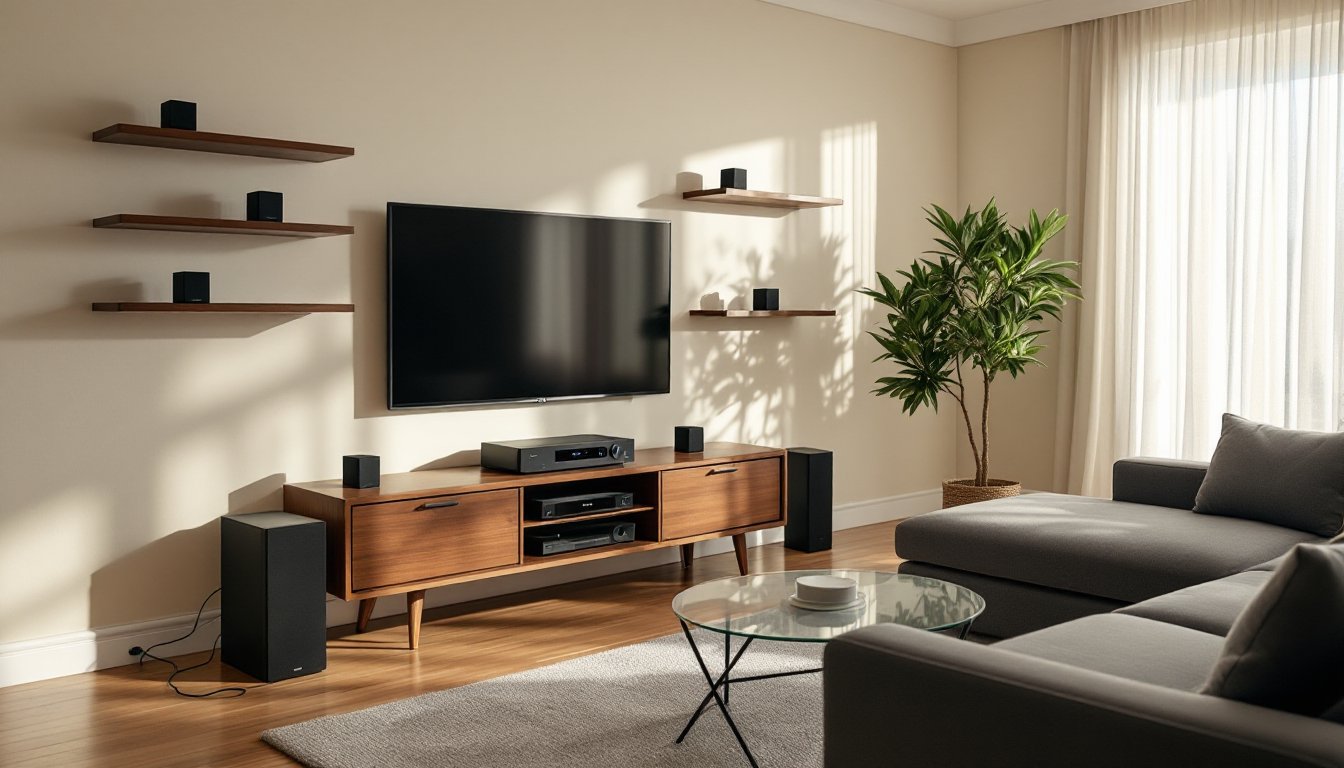
Pairing the Bose Acoustimass 6 Series V with a Yamaha receiver creates a home theater setup that balances compact design with serious audio performance. This bundle appeals to DIYers who want cinema-quality sound without tearing out walls or hiring installers. The Bose system delivers five speakers and a powered subwoofer in a footprint small enough for most living rooms, while Yamaha receivers provide the connectivity and amplification needed to drive them cleanly. This guide walks through what makes this combination work, how to wire it correctly, and where to spend (or save) your budget.
Table of Contents
ToggleKey Takeaways
- The Bose Acoustimass 6 Series V delivers 5.1 channel home theater sound in compact cube speakers paired with a powered subwoofer, ideal for medium-sized rooms up to 300 square feet without professional installation.
- Pair the Bose Acoustimass 6 with a Yamaha receiver like the RX-V4A or RX-V6A to access YPAO auto-calibration, 4-ohm stable amplification, and modern HDMI 2.1 connectivity for gaming consoles.
- Proper setup requires careful attention to crossover settings (120–150 Hz), speaker placement with wall mounting or shelf positioning, and subwoofer placement using the ‘crawl method’ to eliminate room reflections.
- Room acoustics significantly impact performance—add curtains, rugs, and acoustic panels to hard surfaces to improve dialogue clarity and reduce echo from the Bose cube speakers.
- Budget $700–$800 for a complete Bose Acoustimass 6 and Yamaha receiver bundle, with additional costs for speaker wire, mounting hardware, and cable management supplies.
What Makes the Bose Acoustimass 6 Series V Stand Out?
The Acoustimass 6 Series V is a 5.1 channel speaker system built around Bose’s proprietary cube speaker design. Each satellite measures just 3.25 x 3.25 x 3.25 inches, which means they mount flush to walls or tuck onto shelves without dominating the room. The powered Acoustimass module (the subwoofer) handles frequencies below 200 Hz, letting the cubes focus on midrange and treble.
This system uses dual-channel connectivity, each pair of cubes connects via a single proprietary cable, then plugs into the Acoustimass module. From there, standard speaker wire runs to your receiver. It’s not the most flexible wiring scheme, but it reduces cable clutter behind your entertainment center.
Sound-wise, the system emphasizes clarity and dialogue intelligibility over booming bass. The cube drivers use full-range paper cone transducers that reproduce vocals and high frequencies with minimal distortion. The subwoofer is ported and tuned for music as much as explosions, which makes this setup versatile for streaming concerts, gaming, or movie nights.
Professional reviewers note the system’s ability to fill medium-sized rooms (up to 300 square feet) without sounding strained. For larger spaces or open floor plans, you’ll need to supplement with additional amplification or consider a different speaker configuration.
Why Pair Bose Speakers with a Yamaha Receiver?
Yamaha receivers bring the power, processing, and HDMI switching that the Bose system lacks on its own. The Acoustimass module is powered, but it still relies on your receiver to decode Dolby Digital, DTS, and modern object-based formats like Dolby Atmos (if you add height channels later).
Yamaha’s YPAO (Yamaha Parametric Room Acoustic Optimizer) auto-calibration uses a microphone to measure speaker distances, levels, and room response, then applies EQ corrections. This is critical for the Bose cubes, which benefit from precise crossover settings to prevent midrange muddiness. Set your crossover at 120 Hz or 150 Hz in the receiver’s speaker configuration menu to let the Acoustimass module handle the heavy lifting.
Yamaha receivers also include 4-ohm stable amplification, which matters because the Bose cubes present a nominal 4-ohm impedance. Some budget receivers struggle with 4-ohm loads at high volume, but Yamaha’s Class AB amps handle it cleanly without overheating.
Another practical advantage: Yamaha’s HDMI 2.1 ports (on newer models) support 4K/120Hz passthrough, VRR (Variable Refresh Rate), and eARC. If you’re gaming on a PlayStation 5 or Xbox Series X, this future-proofs your setup without requiring a separate HDMI switcher.
Recommended Yamaha Receivers for Your Bose Acoustimass 6
For a 5.1 setup, the Yamaha RX-V385 or RX-V4A deliver 70–80 watts per channel, Bluetooth streaming, and enough HDMI inputs for a cable box, game console, and streaming stick. Expect to pay $250–$350 depending on the model year.
If you want room to expand, the Yamaha RX-V6A adds 7.2 channel processing, which lets you add height speakers or a second subwoofer down the line. It also includes MusicCast, Yamaha’s multi-room audio system, so you can stream to wireless speakers in other rooms. Budget around $450–$550.
For high-end setups, the Yamaha RX-A2A provides 9.2 channels, HDMI 2.1, and more robust YPAO calibration with multi-point measurement. This is overkill for the Acoustimass 6 alone, but makes sense if you plan to integrate ceiling speakers or upgrade to a larger speaker array later. Retail runs $1,000–$1,200.
Setting Up Your Bose and Yamaha Bundle: Step-by-Step Installation
Tools and materials:
- Wire stripper and cable ties
- Drill and 3/16″ bit (for wall mounting cubes)
- Stud finder
- 16-gauge speaker wire (for Acoustimass module to receiver)
- Level (for aligning center channel)
- Safety glasses (when drilling into walls)
Step 1: Position the Acoustimass module. Place it near your receiver, ideally within 15 feet. The module can sit behind a couch, under an end table, or in a corner, it’s not directional, so placement is flexible. Avoid sealing it inside a cabinet: it needs airflow to prevent overheating.
Step 2: Run the cube speaker cables. Connect the satellite cubes to the Acoustimass module using the included cables. The front left/right and rear left/right pairs share a single cable each. The center channel has its own dedicated cable. If you’re running cables through walls, use CL2-rated or CL3-rated wire to meet fire safety codes (required in most jurisdictions for in-wall installation).
Step 3: Mount or place the cubes. For wall mounting, locate studs with a finder and drill pilot holes. The included brackets support vertical or horizontal orientation. Tighten screws snug but not stripped, the cubes weigh less than 2 pounds each, so they don’t require heavy-duty anchors unless mounting to drywall alone. In that case, use toggle bolts rated for at least 10 pounds.
For shelf placement, angle the front left/right speakers inward by 15–20 degrees toward the main listening position. This improves stereo imaging.
Step 4: Wire the Acoustimass module to the receiver. Connect 16-gauge speaker wire from the Acoustimass module’s outputs to your Yamaha receiver’s speaker terminals. Match polarity carefully, red to red, black to black. Reversed polarity won’t damage anything, but it causes phase cancellation that muddies bass response.
Step 5: Run YPAO calibration. Power on the receiver, plug in the YPAO mic, and place it at ear height in your primary seating position. The receiver will emit test tones from each speaker and the subwoofer. This process takes 3–5 minutes. Once complete, verify the crossover is set to 120 Hz or 150 Hz (navigate to Setup > Speaker > Crossover in the receiver menu).
Step 6: Fine-tune subwoofer level. The YPAO calibration often sets the subwoofer too low for movies. Bump it up +3 dB to +5 dB in the receiver’s level settings. Test with a scene that has deep bass (explosions, thunder, or electronic music). Adjust until bass sounds punchy without rattling picture frames.
Optimizing Sound Quality and Room Acoustics
The Bose cubes work best in rooms with minimal hard surfaces. Hardwood floors, large windows, and bare walls cause reflections that smear dialogue and create echo. If your space fits that description, add absorption where it counts.
Hang a thick curtain or acoustic panel on the wall behind the main seating area. This dampens rear-wall reflections that interfere with surround channels. A 6 x 4 foot area rug under the coffee table reduces floor bounce, which improves center channel clarity.
For the subwoofer, experiment with placement before finalizing. Try the “subwoofer crawl”: place the sub in your main seat, then walk around the room’s perimeter while playing bass-heavy content. Where you hear the smoothest, deepest bass, that’s where the sub should go. Corner placement amplifies output but can cause boominess: placing it along a wall (not in a corner) often yields more balanced response.
If you’re in an apartment or have shared walls, engage the receiver’s Dynamic Range Control (often labeled “Night Mode” or “Late Night”). This compresses loud peaks and raises quiet dialogue, preventing neighbor complaints without muting action scenes.
Cable management matters more than aesthetics here, loose speaker wire can pick up electrical interference from power cables. Run speaker wire at 90-degree angles to AC cables when they must cross, and never bundle them together. Use cable ties to secure runs behind baseboards or along crown molding.
Budgeting for Your Home Theater Bundle: Cost Breakdown and Value
As of April 2026, the Bose Acoustimass 6 Series V typically retails for $400–$500 new, though refurbished units appear at $250–$350 from authorized resellers. Pair that with a Yamaha RX-V4A at $300, and you’re at $700–$800 for the core system.
Add $50–$75 for 16-gauge speaker wire (buy a 100-foot spool to avoid running short), wall brackets if not included, and cable management supplies. If you’re hiring an electrician to run in-wall wiring, budget $150–$300 depending on the number of drops and local labor rates.
For comparison, competing 5.1 systems at this price point include the Klipsch Reference Theater Pack (~$500) and the Polk Audio Blackstone TL1600 (~$350). The Klipsch system delivers higher sensitivity and louder output, but the cube speakers are larger and less spouse-friendly. The Polk setup is budget-conscious but uses passive satellites and a less powerful subwoofer.
Industry testing shows the Acoustimass 6 holds its resale value better than most compact systems, expect to recoup 60–70% of purchase price after three years, versus 40–50% for budget brands.
If you’re buying used, inspect the Acoustimass module’s connections and test the subwoofer driver for rattles. The proprietary cables are expensive to replace ($40–$60 each), so confirm they’re included. For receivers, verify HDMI handshake works with your TV, older Yamaha models occasionally have compatibility hiccups with budget 4K TVs.
Conclusion
This bundle delivers cinema-grade sound in a form factor that won’t dominate your living room or require professional installation. Focus on proper speaker placement, run YPAO calibration carefully, and don’t skip the crossover settings. With the right Yamaha receiver powering it, the Acoustimass 6 Series V punches well above its size, just make sure your room acoustics don’t work against it.