
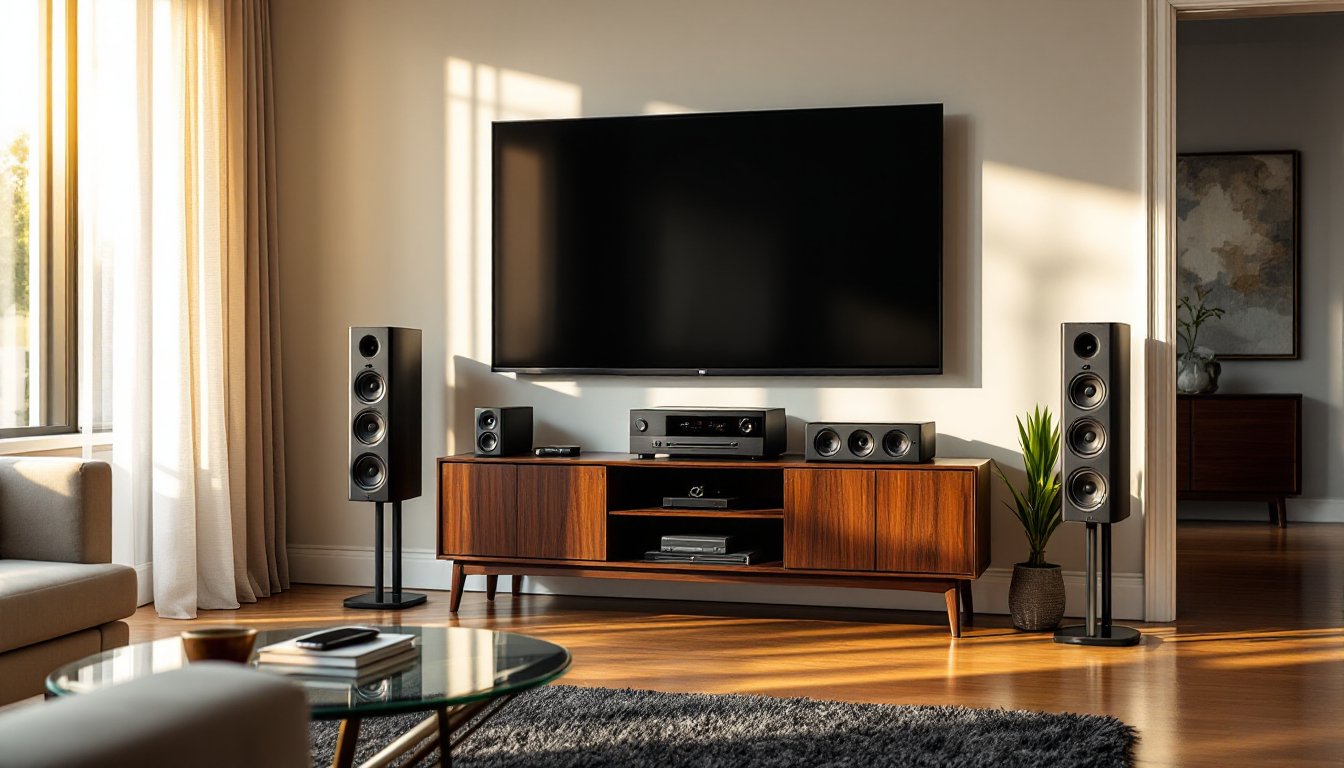
Installing a Denon home theater system isn’t just about buying boxes and plugging them in, it’s about transforming a living room into an immersive audio environment that rivals commercial theaters. Denon’s reputation for clean power delivery, flexible room correction software, and rock-solid build quality makes their receivers and speaker packages a top choice for DIYers who want professional results without paying installer rates. This guide walks through component selection, practical installation steps, and room optimization techniques to help homeowners extract every ounce of performance from their Denon setup.
Table of Contents
ToggleKey Takeaways
- A Denon home theater system with Audyssey MultEQ XT32 room correction eliminates the need for hundreds of dollars in acoustic treatment by automatically compensating for furniture, reflections, and room dimensions.
- Discrete amplification channels and regular firmware updates in Denon receivers ensure clean audio during bass-heavy scenes and future-proof your system for 7–10 years without obsolescence risk.
- Proper speaker placement and the subwoofer crawl method deliver better sound quality than upgrading receiver models, making DIY optimization more cost-effective than purchasing premium components.
- Compliance with NEC Article 725 and use of CL2/CL3-rated speaker wire is essential for in-wall installations to meet fire safety codes and avoid thermal shutdowns.
- Entry-level Denon setups start around $900–$1,200, while prioritizing a quality subwoofer (12-inch with 300+ watts) over premium cables maximizes audio performance within budget constraints.
Why Choose a Denon Home Theater System for Your Home
Denon consistently earns high marks in expert reviews of home theater systems for three reasons: amplifier headroom, processing flexibility, and long-term firmware support. Their AVR (audio-video receiver) lineup offers true discrete amplification channels, not shared power supplies that collapse under heavy bass loads, which means cleaner sound during action sequences and concert films.
Most Denon receivers support Audyssey MultEQ XT32, a room correction suite that measures speaker response at multiple listening positions and applies precision EQ curves to compensate for furniture, wall reflections, and odd room dimensions. This feature alone saves hundreds of dollars in acoustic treatment panels for average living rooms.
Denon also future-proofs setups with regular HDMI chipset updates to support evolving video standards (8K passthrough, eARC, Dolby Vision). If a homeowner plans to keep their receiver for seven to ten years, typical for quality AVRs, Denon’s track record of backward-compatible firmware updates reduces the risk of obsolescence.
From a DIY perspective, Denon publishes detailed setup manuals with labeled terminal diagrams, making first-time installations less intimidating. Their customer support forums are active, and replacement parts (remote controls, binding posts, faceplate trim) remain available long after discontinuation.
Understanding Denon Home Theater Components and Configurations
Receivers and Amplifiers
Denon’s AVR-S series targets entry-level DIYers with 5.2- to 7.2-channel configurations (five to seven speakers plus two subwoofer outputs). Models like the AVR-S760H deliver 75 watts per channel into 8 ohms, enough to drive bookshelf speakers in rooms under 300 square feet without distortion. These receivers include Bluetooth, AirPlay 2, and HEOS wireless multiroom streaming, handy for whole-home audio without running speaker wire through finished walls.
Mid-tier AVR-X models (AVR-X3800H, AVR-X4800H) add pre-amp outputs for external amplifiers, critical if a homeowner wants to upgrade speaker efficiency later without replacing the receiver. They also offer 11.2-channel processing with height channels for Dolby Atmos, which requires ceiling-mounted speakers or up-firing modules. These receivers weigh 20 to 30 pounds due to larger transformers and heat sinks, plan for reinforced shelving if installing in a media cabinet.
Denon’s Cinema series (AVC-X6700H and up) crosses into semi-professional territory with independent power supplies per channel and balanced XLR inputs. Most DIYers won’t need this tier unless building a dedicated theater room with 9.2.4 configurations (nine ear-level speakers, two subs, four height channels). Budget $2,500 to $5,000 for these units alone.
Speaker Systems and Soundbars
Denon partners with Boston Acoustics, Definitive Technology, and Polk Audio for packaged speaker bundles, but they don’t manufacture passive speakers in-house. When comparing Denon home theater options, look for bundles that match speaker impedance (4, 6, or 8 ohms) to receiver specs, mismatched impedance can trigger thermal shutdowns during loud passages.
Typical 5.1 bundles include three front speakers (left, center, right), two surrounds, and one powered subwoofer. Center channel speakers handle 60 to 70 percent of movie dialogue, so prioritize quality here, a three-way design with dual 4-inch woofers performs better than a single-driver bar.
Denon’s Home series soundbars (DHT-S216, DHT-S716H) offer simpler installations for renters or homeowners avoiding in-wall wiring. These units support HDMI eARC for lossless Dolby Atmos passthrough from compatible TVs, though sound quality won’t match discrete speaker systems. Soundbars work well in open-concept rooms where rear surrounds are impractical, but they struggle with accurate stereo imaging in wide seating areas.
Setting Up Your Denon Home Theater: A DIY Installation Guide
Tools and Materials:
• Wire strippers (12–16 AWG capacity)
• Stud finder (magnetic or electronic)
• Drill/driver with paddle bits (½-inch for in-wall routing)
• Speaker wire (14-gauge for runs under 50 feet, 12-gauge for longer distances)
• Banana plugs or spade connectors (optional but recommended for secure termination)
• Cable ties and wire clips
• Laser level (for aligning wall-mounted speakers)
• Safety glasses (drilling overhead)
Step-by-Step Installation:
-
Position the receiver in a ventilated cabinet or open shelf. Denon AVRs generate 200 to 400 BTUs of heat under load, leave 4 inches clearance above and 2 inches on sides. Avoid stacking components directly on top.
-
Run speaker wire before mounting speakers. For in-wall routing, drill through top plates (the horizontal 2×4 or 2×6 at the top of wall framing) and fish wire down to outlet-height access holes. Use low-voltage mounting brackets (Arlington LVA1 or similar) to maintain fire rating compliance.
-
Terminate wires by stripping ½ inch of insulation and twisting strands tightly. Insert into receiver binding posts, ensuring red terminals match positive wire markings. Reversed polarity won’t damage equipment but causes phase cancellation and weak bass.
-
Mount speakers at ear height (36 to 42 inches for seated listening). Use toggle bolts or screw-in anchors rated for 20 pounds minimum, drywall alone won’t support a 10-pound bookshelf speaker long-term. For Atmos height channels, aim speakers at the primary seating position or mount flush in the ceiling using remodel enclosures (8-inch opening minimum).
-
Connect HDMI sources (cable box, Blu-ray, game console) to receiver inputs, then run a single HDMI cable from receiver output to TV. This consolidates switching through the AVR and enables eARC for TV app audio return.
-
Run Audyssey calibration with the included microphone. Place the mic at head height in the primary seat, then follow on-screen prompts for 6 to 8 additional measurement positions. Calibration takes 10 to 15 minutes and should be repeated if furniture moves or large rugs are added.
Permit and Code Notes: Running speaker wire inside walls requires compliance with NEC Article 725 (Class 2 and 3 circuits). CL2- or CL3-rated wire is required for in-wall installations to meet fire safety standards. Cosmetic surface-mount installations don’t require permits in most jurisdictions, but consult local AHJ (Authority Having Jurisdiction) if drilling load-bearing walls.
Optimizing Room Acoustics and Speaker Placement
Speaker placement affects sound quality more than receiver price. Start with the front left and right speakers flanking the TV at equal distances, toed in 10 to 15 degrees toward the center seat. This narrows the stereo image and reduces early reflections off side walls.
Place the center channel directly above or below the screen, angled toward ear height if mounted high on a mantel. Avoid recessing it inside furniture, fabric grilles and cabinet doors muffle high frequencies.
Surround speakers belong at 90 to 110 degrees from the front speakers, mounted 1 to 2 feet above seated ear height. Dipole surrounds (speakers with out-of-phase drivers on opposite sides) create diffuse sound fields and work well in smaller rooms where listeners sit close to rear walls. Direct-radiating surrounds offer better localization for gaming and immersive music formats.
Subwoofer placement gets tricky due to room modes, standing waves that cause peaks and nulls at specific frequencies. The “subwoofer crawl” method works: place the sub in the main listening position, play bass-heavy test tones, then crawl around the room’s perimeter listening for the smoothest bass response. That spot becomes the sub’s permanent location. Corner placement boosts output by 6 to 9 dB but often emphasizes boominess: mid-wall positions yield flatter response.
For budget-friendly acoustic treatment, add thick curtains to large windows and place bookshelves or diffuser panels on the wall behind the seating area to break up rear reflections. Skip foam pyramid panels, they only absorb treble. Effective bass traps require 4-inch mineral wool panels in room corners, which can be DIY-built using Roxul Safe’n’Sound and fabric-wrapped frames.
Audyssey calibration compensates for many room issues, but it can’t fix nulls caused by seating positions at quarter- or half-wavelength distances from walls. In a 14-foot-long room, avoid placing the couch exactly 7 feet from the front wall, shift it forward or back 18 inches to escape the null zone for 80 Hz bass.
Budget Considerations: Finding the Right Denon System for Your Space
Entry-level Denon systems, AVR-S660H paired with a Polk Monitor XT70 5.1 bundle, start around $900 to $1,200 (prices vary by region and retailer promotions). This tier suits apartments and rooms under 250 square feet where neighbors or HOA noise ordinances limit playback levels.
Mid-range setups with an AVR-X2800H and higher-sensitivity towers (90 dB or above) run $1,800 to $2,500. These configurations handle medium to large living rooms (250 to 400 square feet) and support future expansion to 7.2.4 Atmos layouts without replacing the receiver. Factor in $200 to $400 for quality speaker wire, HDMI cables (certified Ultra High Speed for 8K), and wall-mount hardware.
High-end dedicated theater builds with Denon’s Cinema series receivers and premium speakers (KEF, Focal, SVS) easily exceed $8,000 to $15,000. At this tier, professional installation reviews recommend hiring a calibrator with measurement-grade microphones and acoustical analysis software, DIY Audyssey calibration leaves 10 to 15 percent performance on the table compared to manual tuning.
Cost-Saving Tips:
• Buy previous-generation receivers when Denon releases annual updates (typically spring). Features stay relevant for years, HDMI 2.1 from 2021 models still handles current gaming consoles.
• Skip expensive “audiophile” cables. Monoprice or Blue Jeans Cable offer certified HDMI and properly gauged speaker wire at one-third the cost of boutique brands.
• Start with 3.1 (left, center, right, sub) and add surrounds later. Most movie soundtracks prioritize front channels, and incremental upgrades spread budget impact.
Don’t cheap out on the subwoofer, a quality 12-inch sealed or ported design with 300+ watts delivers tighter bass than dual 8-inch models at similar cost. Subwoofers handle the most demanding power loads, and underpowered units distort at reference levels (105 dB peaks for THX calibration).